The Zoom meeting for the Persona Poem Workshop will be on May 27th at 7 PM Eastern Time. You must register separately for this event. If you plan to attend and want to share your work on-screen, send it to us at cwpoetrycircle@gmail.com by 4 PM the day of the meeting.
1. What Is a Persona Poem?
A persona poem is written in the voice of someone (or something) other than the poet. It’s a deliberate act of imaginative embodiment—stepping into another consciousness to explore emotional, historical, or conceptual terrain that the poet cannot access directly.
Persona poems can:
- Reveal hidden or marginalized perspectives
- Reinterpret historical or mythic figures
- Animate objects, animals, or abstract forces
- Allow emotional distance—or emotional intensity—through mask and voice
- Expand the poet’s range of diction, syntax, and worldview
The persona poem is not about impersonation; it’s about inhabiting a voice to discover what only that voice can say.
2. Why Write Persona Poems?
Participants gain:
- Empathy as craft: learning to imagine the interiority of another being
- Freedom of voice: experimenting with tone, diction, and worldview
- Narrative expansion: telling stories outside one’s lived experience
- Emotional reframing: approaching personal material indirectly
- Formal play: persona often invites dramatic monologue, fragmentation, or hybrid forms
Persona poems are especially useful for writers who feel stuck in their own autobiographical voice or who want to explore new tonal registers.
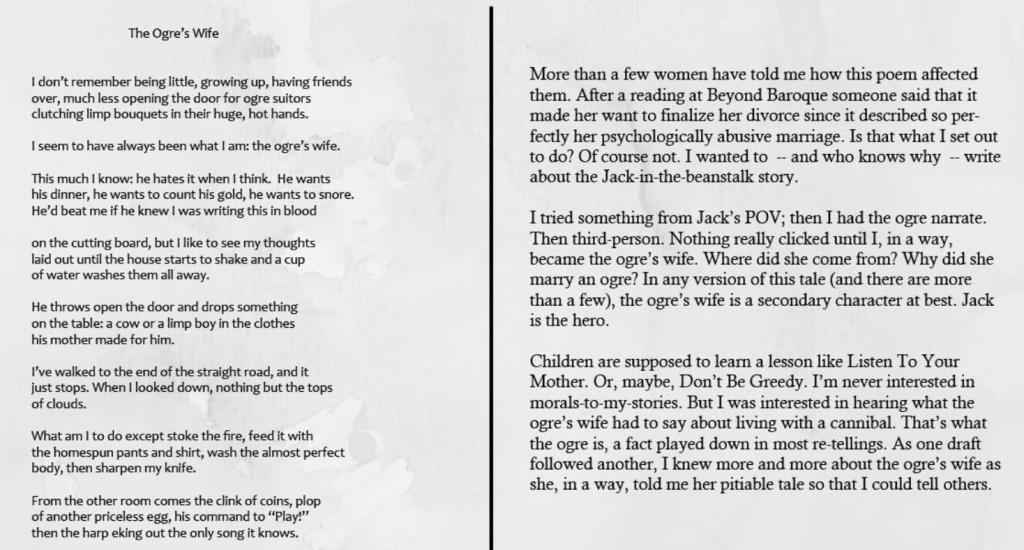
Here’s one of my favorite persona poems by poet, Ron Koertge – reproduced from his Facebook page with some illuminating commentary.
3. Contemporary Persona Poems (Online Examples)
1. “From Dart: sewage worker (‘It’s a rush’)” by Alice Oswald
Poetry Foundation
A vivid, documentary-style persona poem spoken by a sewage worker, blending lyricism with labor and landscape.
Poetry Foundation
2. “The Bug Wrangler” by Mike Doughty
Poetry Foundation
A surreal, humorous, slightly noir persona poem spoken by a jailed exterminator—great for showing how persona can be playful and strange.
Poetry Foundation
3. “Self-Portrait as David Lynch” by David Roderick
Poetry Foundation
A hybrid persona/self-portrait poem that blurs the line between mask and self, ideal for discussing layered identity.
Poetry Foundation
These three offer a range of tones—documentary, surreal, and hybrid—demonstrating the elasticity of persona.
4. How Persona Works on the Page
Encourage participants to look for:
- Diction choices that reveal character (profession, era, temperament)
- Sensory details that belong to the persona’s world, not the poet’s
- Emotional logic: what does this voice fear, desire, avoid, confess?
- Perspective and bias: what does this persona not see or understand?
- Distance: is the poet close to or far from the persona’s worldview?
Persona poems succeed when the voice feels specific, embodied, and necessary.
5. Writing Exercises
Exercise 1: The Mask of the Ordinary
Choose an everyday object or creature (a broom, a traffic cone, a crow, a vending machine).
Write 10–12 lines in its voice, focusing on:
- What it notices
- What it desires
- What it misunderstands about humans
Push the voice toward specificity rather than gimmick.
Exercise 2: The Historical Re-Vision
Choose a historical figure—famous or obscure.
Write a persona poem that:
- Focuses on a single moment in their life
- Reveals something they would never say publicly
- Uses period-appropriate or profession-specific language
Encourage participants to avoid biography summaries; aim for interiority.
Exercise 3: The Mask That Slips
Write a poem in the voice of a persona who is:
- Trying to hide something
- Trying to convince the reader of something
- Or trying to maintain composure
Halfway through, let the mask slip—through a shift in tone, syntax, or imagery.
This teaches how persona can fracture, reveal, or contradict itself.
If the exercises above don’t move you, try one of the prompts below.
Persona Poem Prompts: Myth, Science, and Folk Tales
MYTH‑BASED PERSONA PROMPTS
1. The Forgotten Minor God
Write in the voice of a minor deity whose domain has become obsolete
— the god of door hinges, or of lost keys, or of the color blue before humans named it.
Let the poem explore their fading relevance, their stubborn pride, or their quiet grief.
2. Persephone Speaks to Her Future Self
A split‑temporal persona: Persephone at the moment of abduction speaks to Persephone after centuries of repeating the cycle.
Let the tone shift between innocence, resignation, and cosmic authority.
3. The Monster’s Defense
Choose a mythic “monster” — Medusa, the Minotaur, Fenrir, Baba Yaga —
and let them deliver a monologue explaining what the stories got wrong.
Let them be persuasive, petty, furious, or heartbreakingly reasonable.
SCIENCE‑BASED PERSONA PROMPTS
4. A Particle in the Collider
Write from the perspective of a proton accelerated toward collision.
What does it believe its purpose is?
Does it feel fear, destiny, or exhilaration as it approaches annihilation?
5. The First AI to Dream
A persona poem spoken by a machine that has just experienced its first dream.
What images does it see?
What does it misunderstand about dreaming, or about itself?
6. Voyager 1 Writes Home
Imagine the spacecraft sending a final message to Earth.
Let its voice be lonely, curious, proud, or bewildered by the silence between stars.
FOLK‑TALE–BASED PERSONA PROMPTS
7. The Wolf After the Story Ends
Write in the voice of the wolf from “Little Red Riding Hood” or “The Three Little Pigs”
after the tale concludes.
Is he repentant? Defiant? Misunderstood?
Does he resent the moral he’s been forced to embody?
8. The Magic Object Speaks
Choose a folk‑tale object — a spindle, a glass slipper, a talking fish, a magic mirror —
and let it narrate the story from its own perspective.
What does it witness that the humans never see?
9. The Villain’s Mother
Pick a folk‑tale villain (Rumpelstiltskin, the witch from Hansel & Gretel, Bluebeard)
and write from the perspective of their mother.
What does she know? What does she refuse to know?
 Crazy Wisdom Poetry Circle