Loss, Restraint, and What Gets Left Behind
A Workshop for the Crazy Wisdom Poetry Circle
The live virtual meeting for this workshop will be on September 23rd, 2026 at 7 p.m. Eastern time via Zoom. You’ll need to register to receive the link. When you receive the link you can send work you want to share at the meeting via return email. Links are sent the Sunday before each event.
What Is an Elegy?
An elegy is a poem written in response to loss. That definition sounds simple, but it opens onto a surprisingly large territory. The loss can be a death — a parent, a friend, someone you barely knew. It can be something less final: a relationship, a version of yourself, a world that no longer exists. It can be addressed to someone whose status is uncertain. It can mourn what was never fully possessed, or what was never said.
It is important to point out that elegy and eulogy are not the same thing. Elegy is written to reflect on loss, process grief, and explore mortality. Eulogy is meant to praise and recount the life of someone who has died.
What makes a poem an elegy isn’t subject matter alone. It’s a particular emotional stance: the speaker is reckoning with absence. Something that was present is no longer, and the poem is the act of reckoning.
What remains is the emotional arc: the acknowledgment of loss, some attempt to look at it clearly, and (sometimes, not always) a form of survival.
What Elegies Do Wrong
Most failed elegies fail for one of three reasons.
They over-explain the feeling. The poet tells the reader what to feel rather than showing what happened. “I was devastated” is not an elegy; it’s a summary of one. The feeling has to arise from the poem’s material, not be announced.
They settle into abstraction too quickly. Grief is general; a specific person or object is particular. The poem that moves too fast from the particular to the universal (“she was the light of my life, and now that light is gone”) loses what made the subject irreplaceable. The irreplaceable detail — a dress, a piece of jewelry, a song, a photgraph — is where the elegy lives.
They reach for a consolation before earning it. The poem that resolves grief too neatly — “but she lives on in our hearts” — asks the reader to accept a comfort the poem hasn’t worked for. The elegies that endure tend to sit with the loss longer, and when consolation comes, it arrives earned, not assumed.
Three Principles Worth Practicing
Trust the object. Physical things carry emotional weight in ways that abstract statements don’t. What did the person leave behind — literally, not figuratively? What did you do with it? What happened to it? A poem built from objects doesn’t have to say “I miss him.” The objects say it.
Leave room for what you don’t know. The speaker’s uncertainty — about the dead, about themselves, about what comes next — is often more moving than confident statement. Not knowing someone’s real name, not having written the poem when you should have, not knowing what you would have said — these gaps are part of the truth of loss.
Cut toward compression. Elegies accumulate weight through what they leave out. Every phrase that tells the reader how to feel is a phrase that could have trusted them to feel it. Every line of explanation is a line that could have been another image. When in doubt, cut.
3 Model Poems
These poems illustrate three different approaches to elegy.
The Falls in Winter was written by David Jibson, Editor in Chief of 3rd Wednesday Magazine, and is used here with his permission. It was originally published in Ephemeral Elegies.
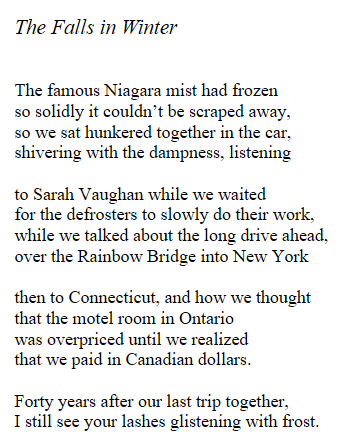
This elegy spends twelve of its fourteen lines refusing to be an elegy — it’s a road-trip anecdote, wry and specific: frozen mist, Sarah Vaughan on the radio, defrosters working slowly, a mix-up over Canadian dollars. Nothing in that texture signals grief. Then the volta arrives in the final couplet — “Forty years after our last trip together” — and the whole poem reorganizes itself in retrospect: every detail we just read as incidental becomes elegy, and we’re sent back through the poem to re-see it. The unrhymed sonnet form earns its keep, giving the poem exactly the turn it needs to keep its plain-speech register. The closing image — lashes glistening with frost — never explains what forty years of absence feels like. It just hands us one physical detail and trusts it to carry everything the poem has been withholding.
Father by Ted Kooser
https://www.tedkooser.net/excerpts/father.html
“Father” earns its elegiac weight through a structural gamble: Kooser spends the poem’s opening lines imagining his father alive at ninety-seven, then undercuts that fantasy by admitting the imagined scenario would be wretched for everyone involved — endless medical appointments, a frightened old man, two exhausted adult children trying to navigate his decline. This is the poem’s sideways move, and it’s instructive for anyone working on closing turns in elegy: instead of the expected grief-for-loss, Kooser offers relief-at-loss, and the relief is what unlocks the actual missing. Grief arrives only after the poem has cleared away the sentimental alternative.
The closing move is the real craft lesson. Kooser pivots to the father’s own birth story — the detail that lilacs were blooming when he was born — and then notes, in the present moment of writing, that lilacs are blooming again. That’s not a metaphor stated and explained; it’s an image set down and left alone, doing the work of continuity, return, and memorial all at once without the poem ever saying those words. The line about Iowa “still welcoming” him is the only place Kooser allows himself something close to a direct claim, and even that is phrased through landscape rather than emotion — the place itself extends the gesture, not the speaker. The lilacs carry the entire emotional argument that the rest of the poem has earned the right to leave unspoken.
Elegy [“I think by now the river must be thick”]
By Natasha Trethewey
https://www.poetryfoundation.org/poems/57695/elegy-i-think-by-now-the-river-must-be-thick
Trethewey’s “Elegy” works by collapsing two timelines into one fishing trip: the actual morning on the river with her father, and the future moment — already implied in the title — when she’ll be writing his elegy. The poem’s central admission is its sharpest move: she confesses that even while the day was happening, she was watching it as material, already composing the elegy she knew she’d eventually need. That self-implicating honesty (calling herself “ruthless,” then complicating it by saying she learned to be that way) keeps the poem from becoming a simple nostalgic remembrance. It’s elegy aware of its own making — grief that knows it’s rehearsing for grief.
The released trout carry the poem’s central image without the poem ever stating its meaning outright: two fish caught and then required to go free, slipping out of her hands despite her grip, becomes the vehicle for everything she can’t yet say about her father’s mortality. That’s the sideways move — the fish are real, specific, sensory (the hooks worked loose, the writhing in her hands), and only in retrospect, by poem’s end, do they accrue their full weight as a rehearsal for loss. The final image extends that logic: in recurring dreams, she’s in the boat again, but now facing backward, watching the bank recede, her back turned to where she knows they’re headed. She never says “death” or “grief”. That’s obliqueness doing exactly what direct statement couldn’t: the poem ends not on resolution but on a posture, a refusal to look at what’s coming, which is itself the most honest thing an elegy written in advance of loss can do.
3 More Elegiac Poems to Consider
https://www.poetryfoundation.org/poems/57224/fragment-56d23a820a69a
https://www.poetryfoundation.org/poetrymagazine/poems/40471/posthumous
https://www.poetryfoundation.org/poems/56547/outgoing-56d23924c5304
Exercises
Exercise 1: The Object Inventory
Make a list of things a person left behind — literally. This can be someone dead, someone gone from your life, a version of yourself. Don’t edit; just accumulate. Include the specific: brand names, sizes, the particular. What happened to each thing? Write a draft that traces the objects without commenting on the feeling. Let the objects do the work.
Exercise 2: Yesterday and Today
Like the Trethewey poem, visit a place, activity or an event that reminds you of a loss in two different timelines. Note details that are the same and those that are different. It could be a family trip with and without someone, a holiday that changes over time. The present visit can be real or imagined, even a dream or fleeting memory, anything that reminds you of the loss. Remember, don’t tell us about your grief. Let the reader feel it through your restaint.
Exercise 3: The Elegy for the Living
Write an elegy for someone who has not died. The subject can be a relationship that ended, a version of a person you once knew, someone you’ve lost track of. The subtitle can announce the complication, for Trudy, who may or may not be dead. Let the uncertainty be part of the poem rather than something to resolve.
Exercise 4: Elegy and the Photograph
Writing the elegy dovetails nicely into our earlier workshop on “Writing from a Photograph”. An elegy drawn from a photograph works best when you resist the urge to describe the whole image and instead let one detail carry the weight. The photograph gives you a fixed moment, but grief isn’t fixed, so the poem’s real work is the gap between what the image freezes and what time did afterward; that gap is where the poem actually lives. Resist sentiment by staying concrete. Let the emotion arrive as a byproduct of precision rather than as something stated outright. Often the strongest move is to let the photograph itself become a small failure: to notice what it didn’t capture, what’s cropped out, what the person in it didn’t know. That unspoken absence, more than any direct address is usually what makes the elegy land. Resist the urge to end the poem with summary.
A note on revision: When your draft is done, read through it and mark every sentence that tells the reader how to feel. Every word like heartbroken, devastated, beautiful, precious. Then ask: does the poem earn that statement from what surrounds it, or is the statement doing the emotional work the images should be doing? Cut toward the images. Trust the reader.

